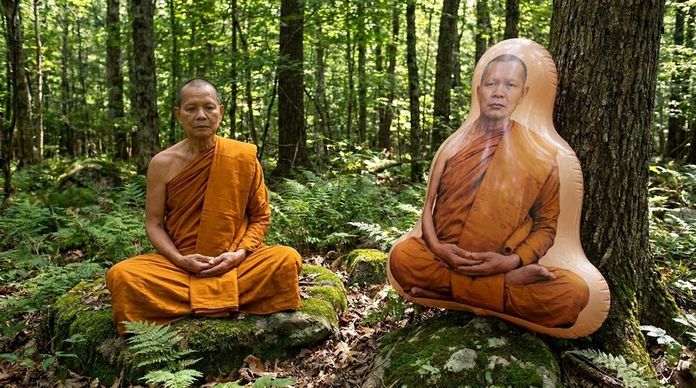

The most blissful yoga session of my life didn't come from a guru.It didn't come from a famous lineage,or from a teacher who had spent months in an Indian ashram.It came from an instructor at an ordinary American gym,one the other yoga teachers mocked behind her back.They called her 'Aerobics Jane'. This is a post about yoga and jhāna,about how stretching the body can open the door to the jhāna…

Blog
Recent posts


I made a big update to the EBPedia page for viveka:lucid24.org/tped/v/viveka Section 2.1 collects suttas that gloss viveka explicitly.The word is right there in the text, followed by an explanation of it,and in those passages 'seclusion' just doesn't work. It has to be discernment. The new section 2.4 collects implicit glosses of viveka.The word itself is never stated,but the context makes it clear we are being shown what viveka is…

Standard 4 Brahmavihāra Mettā Formula PāliEnglish🤝🤗 mettā-sahagatena cetasā🤝🤗with a mind of friendly-kindness,ekaṃ disaṃ pharitvāpervade [that mind state] in the direction [of the first quarter, without limit].viharati,Live in this way.tathā dutiyaṃ,likewise (the) second [quarter],tathā tatiyaṃ,likewise (the) third [quarter],tathā catutthaṃ;likewise (the) fourth [quarter],iti uddham-adhoThus above,-below,tiriyaṃ sabbadhiacross, everywhere,Sabb-atta-tāyato all, and to myself,sabbāvantaṃ lokaṃ(to the) entire world🤝🤗 mettā-sahagatena cetasā🤝🤗with a mind of friendly-kindness,vipulena maha-g-gatenavast, exalted,appamāṇena a-verenaunlimited, without-vengeful-animosity,A-byāpajjena pharitvāwithout ill will, pervade [that mind state…

The Burmese and Sinhala editions of this sutta give mettā ceto-vimutti as the antidote for ill will. The Thai edition has just the unqualified ceto-vimutti as the antidote.Thanissaro explains that here it covers all four brahmavihāras —not the ceto-vimutti of the formless attainments,nor the liberation of mind of an arahant. Sujato translates the Burmese edition.Thanissaro translates the Thai. While the suttas frequently recommend mettā as the antidote for ill will…

Introduction AN 5.162 is interesting in that its first four methods deal with ways to handle resentmenttoward people with character flaws,but the fifth method is for a flawless person,pure in body, speech, and mind.Why would anyone resent a pure person?The sutta and its commentaries don't explain,so I asked Claude AI to propose reasonable possibilities. The second part of this article deals with the strange modern teachingthat muditā (rejoicing [in skillful…

Yesterday's post, Why Everyone, Not Just Monastics,Needs to Work on First Jhāna, has been updated with two additions. The first jhāna terms, and a garden in the junkyard The section What first jhāna actually trains now names the first jhāna terms behind the junkyard skill.In the middle of all that toxic waste,the monk is tending a garden: You reach for the skillful ones (vitakka),turn them over (vicāra), water them with…

Picture a junkyard.Toxic green paste glows between rusted barrels leaking who-knows-what.Sharp metal edges jut out at ankle height.Chained dogs snarl at the perimeter.And walking calmly through the middle of it is a monk in saffron robes,placing each foot with total precision — never near the hazards,never touching the paste, never provoking the dogs. Now picture three other people in that same junkyard,arms already overflowing with jagged scrap and dripping toxic…

Picture it: world famous professor at a prestigious university.Behind the desk sits a teacher who has already solved the oneproblem every human being on earth is quietly struggling with — how to completely eradicate suffering.The sign on his door reads: Office Hours: Every day, every hour. No appointment needed.No fee.No waitlist.He is simply always in. And right outside, a line of people shuffles past his open door,heads down, thumbs moving,…

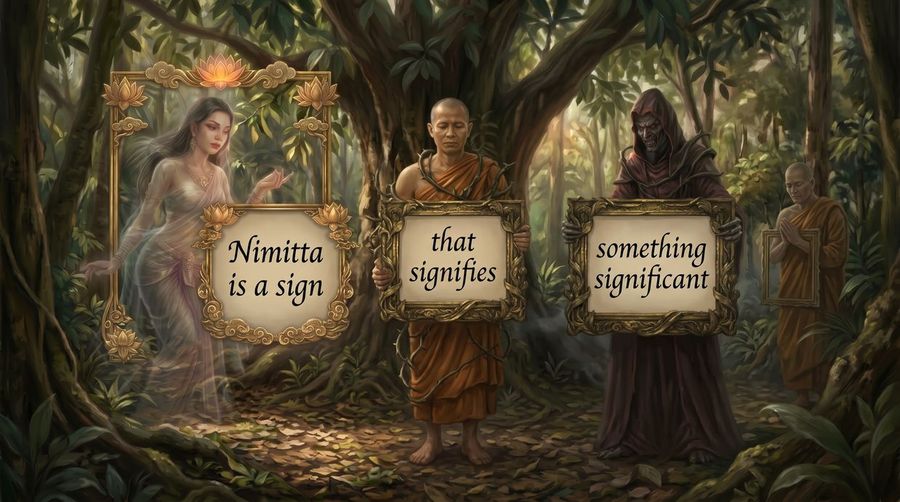
This is why I try to consistently translate nimitta as "sign" everywhere.Because you lose the connection to the Pāḷi word if you translate a subtle English meaning in each context,such as these in the DPD dictionary: nimitta 1 nt. mark; sign; symbol; indication; lit. measured down nimitta 2 nt. mental feature; aspect of experience; lit. measured down nimitta 3 nt. sign; omen; portent; lit. measured down nimitta 4 nt. (interpretation…

This is one of the most important suttas there is,as far as giving you the power tools to address the root causes of greed,anger, delusion, and the 5 hindrances. Other religions give you what sounds like good advice —"turn the other cheek", "lust is a sin" — but they don't actuallygive you the tools to address the underlying root causes.They hack away at the weeds without ever uprooting them. yoniso…
Browse by month
Categories
- Asubha (1)
- Brahmavihāra (1)
- Chanting (1)
- Jhāna (4)
- Nimitta (2)
- Right Speech (2)
- Samādhi (1)
- Sati (1)
Popular

I found an error (IMO) that translators make in AN 5.161. The expression a·sati·a·manasi·kāro occurs in two suttas,and in both of them it clearly has the same meaning. In MN 20, a meditator attempting to attain the 4 jhānas has 5 strategies for abandoning unwanted thoughts.In AN 5.161, a meditator dealing with resentment and hatred has 5 strategies.Clearly both suttas aim at the same meaning with a-sati. The meditator is…

Welcome. Notes on the Dhamma is a place for jotting down what matters — small reflections on the Buddha's Dhamma, written wherever life happens to find me. Focus on what's important Keep coming back to what actually matters. A lucid, discerning mind travels well — under the trees, or high above the clouds. …even with all the Mickey Mouse business going on around you And when the world favors strange…

There's a phrase that's supposed to signal sincerity but does the opposite.Honestly.To be honest.To tell you the truth.People drop it into conversation like a verbal handshake,a little flag planted to say this part is real.But a flag only means something if the rest of the ground isn't also real.And that's the problem.The moment you tell me this sentence is the honest one,you've told me something far more unsettling: that the…