
I made a big update to the EBPedia page for viveka:
lucid24.org/tped/v/viveka
Section 2.1 collects suttas that gloss viveka explicitly.
The word is right there in the text, followed by an explanation of it,
and in those passages ‘seclusion’ just doesn’t work. It has to be discernment.
The new section 2.4 collects implicit glosses of viveka.
The word itself is never stated,
but the context makes it clear we are being shown what viveka is doing,
right before the standard first jhāna formula (‘vivicc’eva kāmehi, vivicca akusalehi dhammehi‘) appears.
Here is section 1.0 of the page, which sums it up.
Viveka = judicious-seclusion, not just ‘seclusion’
Almost everyone translates viveka as ‘seclusion’.
But look at where the word comes from.
Its pre-Buddhist usage (viveka 1.1) and the Sanskrit dictionary (viveka 1.2) agree:
viveka was originally understood as discernment, the ability to tell one thing apart from another.
The Digital Pāḷi Dictionary (viveka 1.3) treats it as two words with two meanings for two contexts,
1. seclusion and 2. discernment,
even though it gives both the same root (vi + √vic, to sift apart).
My theory is that the Buddha intended discernment, as the word had always meant,
and augmented it with seclusion. Hence ‘judicious-seclusion’: seclusion that comes from discernment.
The augmentation makes a point.
In the Buddha’s dispensation, a theoretical understanding that one should discern skillful from unskillful is not enough.
That understanding is sealed only when one is actually secluded from unskillful Dharmas, both mentally and physically,
because right view and discernment have done their work together with samādhi,
and have arrived at genuine behavior that reflects that understanding.
That is very different from blindly following the Buddha’s injunction to physically seclude oneself from unskillful Dharmas.
The evidence follows: the word’s history and dictionary meanings in sections 1.1 to 1.3,
suttas where context decides between ‘discernment’ and ‘seclusion’ in viveka 2,
and suttas where viveka is at work even though the word never appears in viveka 2.4.
Two short video clips show the difference.
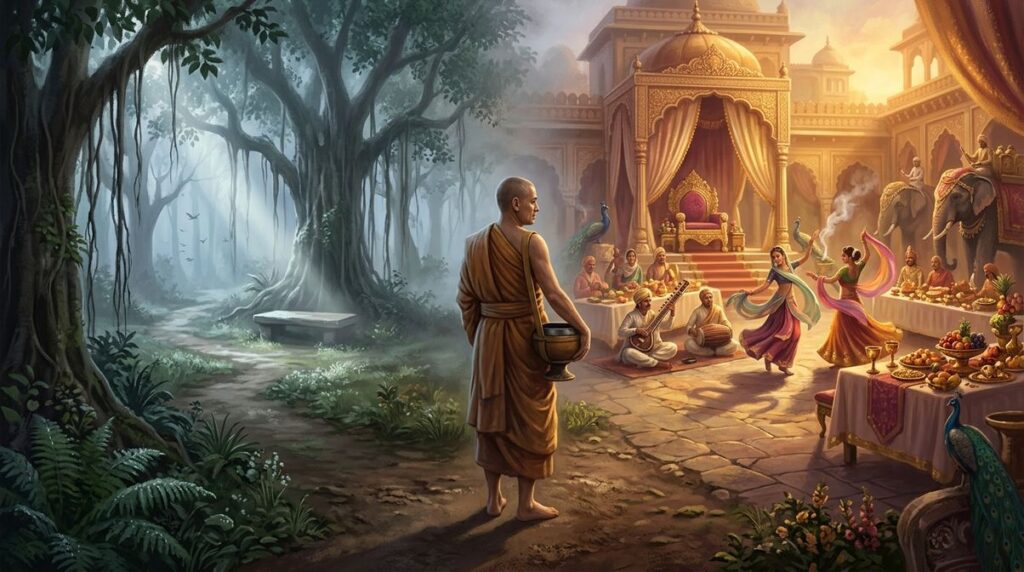
Just ‘seclusion’: the body leaves, the desire comes along
He leaves the palace for the forest because he was told to, without having seen the drawbacks of sensual pleasures for himself.
Sitting alone, the pull of what he left behind returns, and he runs back to it.
Judicious-seclusion: secluded by discernment
He has seen through sensual pleasures for himself, so his seclusion is in the mind, not just the location.
When the temptations come to him in the forest, they pass by without moving him.







Better yet, share your thoughts on the Notes on the Dhamma forum — comments to the blog here often get spammed and ignored.