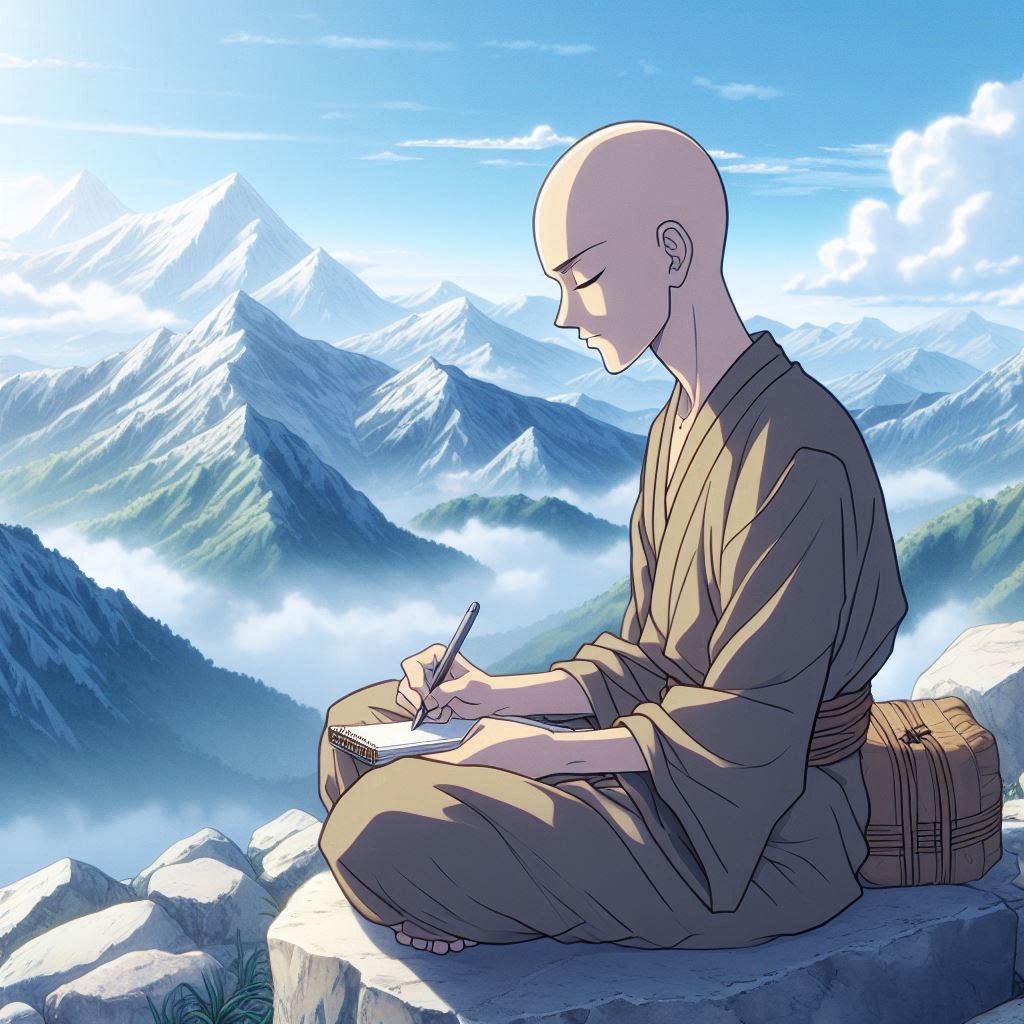

Moggallāna is sitting in the forest near Kallavāḷamutta Village,
nodding off.
The Buddha sees it from the deer park at Bhesakaḷā’s Wood,
teleports over, sits down on the seat laid out for him,
and asks:
“Pacalāyasi no tvaṃ, moggallāna?”
— “Are you nodding off, Moggallāna?
Are you nodding off?”
What follows in AN 7.61 is a list of seven methods for driving off drowsiness,
in a fixed order, each one introduced by the same formula:
“But what if that doesn’t work?
Then…” Most people read this as a grab-bag of practical tips.
It is not a grab-bag.
The order is the whole point, and once you see what orders it,
the sutta turns into one of the clearest pieces of evidence in the canon about what vitakka and vicāra actually are.
Why this sutta baffled me for decades
When I first learned and studied this sutta decades ago,
it seemed strange, a little abstract,
and I couldn’t figure out how to actually apply it.
So I never used the methods the way they are described here,
in that order.
That changed a few years ago,
once the principles of jhānic force,
the jhāna battery,
and the JASI effect became clear to me.
Then I understood exactly which jhānas each of these methods belongs to,
and why the seven are in the order they are in.
Once I had that realization, I memorized the seven steps.
I apply them regularly now, whenever I get drowsy.
That is what you are supposed to do with them.
When the Buddha gives you instructions in an oral tradition,
you memorize the Dhamma and you apply the Dhamma —
which is what sati actually means:
remembering the Dhamma and applying it,
not the vague “mindfulness” it usually gets translated as.
Instructions are no use sitting in a book
while you are nodding off on the cushion.
So hopefully this more detailed explanation of a sutta that baffled me before
is clearer to you than it was to me,
and gives you the motivation to memorize the seven methods
and apply them in your own practice.
Commit the list of 7 to memory
Just takes a few minutes to memorize.
Then immediately you can use it as prime candidate for method #2, using that as the vitakka and vicāra, mentally recite the list of 7 methods.
Meditate before you go to sleep every night,
you’re sure to hit drowsiness before you sleep, so you’ll have it memorized and part of your toolkit to use in no time.
The seven methods are an energy ladder
Read the seven in sequence and ask one question of each: how much energy does this cost to do?
- Stop attending to the perception you were meditating on — costs nothing (implied: switch perceptions to a different meditation topic which doesn’t make you drowsy).
- Think the Dhamma over mentally — costs a little.
- Recite that same Dhamma out loud — costs more; you are now moving air and vocal cords.
- Pull your earlobes, rub your limbs with your hands — now the body is working.
- Get up off the seat, splash water on your eyes,
look around at the stars — standing,
walking to water, eyes open and scanning. - Perception of luminosity, day and night — a whole-system change in how much light your nervous system is processing.
- Walking meditation — the most physically demanding thing on the list.
That is a monotonically increasing energy ladder.
The Buddha starts Moggallāna at the cheapest possible intervention and only escalates when the cheap one fails.
Nobody assembles a list in that order by accident.
Which tells you what the Buddha thinks drowsiness is.
It is not a moral failure and it is not primarily the hindrance of sloth-and-torpor being scolded away.
It is a power problem.
The jhāna battery is low, and the fix is to put energy back into the system —
starting with the method that wastes the least of what little is left,
and that is also the least disturbing to higher and deeper levels of samādhi.
This is the jhāna flat tire seen from the inside.
Jhānic force is always trying to clear blockages and heal the body,
and that healing work draws down internal reserves.
When enough has been spent, you do not get a gentle taper —
you fall off a cliff into sudden sleepiness.
The JASI effect (Jhānic Automatic Spinal Inflation) goes soft:
the spine stops holding itself up,
the lower back slumps, the head tips forward,
and it can happen so slowly you don’t notice until you are already gone.
Seven methods, ascending.
What the sutta is handing Moggallāna is a repair kit for a jhāna flat tire.
1. Don’t attend to the perception that made you drowsy
“So, Moggallāna, don’t focus on or cultivate the perception that you were meditating on when you fell drowsy.”
Read that sentence slowly, because it is doing more work than it looks.
The Buddha’s first move assumes that a meditator in a deep state is attending to a perception (saññā),
that he can be told which perception it was,
and that he can choose to stop attending to it and attend to something else instead.
All three assumptions are impossible if jhāna is what it is popularly claimed to be — a frozen stupor,
the mind welded to a visual kasiṇa,
the five senses shut down, no volition available.
And this is not an isolated phrase.
AN 9.41 is the Buddha narrating his own progress through all nine attainments,
and at every single level the problem he reports is a perception intruding:
Tassa mayhaṃ, ānanda, iminā vihārena viharato vitakkasahagatā saññāmanasikārā samudācaranti.
Svassa me hoti ābādho.“While I was in that meditation, perceptions and attentions accompanied by directing-thought beset me,
and that was an affliction for me.”
Saññā-manasikārā — perceptions-and-attendings.
That is the second jhāna being interrupted by Dharmic thoughts from first jhāna.
In the space-infinitude dimension it is perceptions of form that beset him;
in consciousness-infinitude it is perceptions of space;
and so on up through neither-perception-nor-non-perception.
All the way from 4 jhānas into the formless attainments,
the sutta’s own vocabulary for what is happening in advanced states of samādhi is attending to perceptions.
A mind in a frozen stupor cannot be “beset by perceptions and attendings,”
because it is not attending to anything that requires thought, or the mental processing of data.
What the language of AN 9.41 describes is a mind that is
mentally processing a meditation topic — a Dhamma theme,
or mettā, or muditā for example — and occasionally
the physical body getting physically tired or mentally bored, leading to drowsiness.
That is what the Buddha is troubleshooting for Moggallāna in method 1:
you picked the wrong topic,
or the right topic in a way that put you to sleep.
Drop it.
Pick another.
2. Think the Dhamma over with V&V 💭, and equanimously observe it
“Then think about and consider The Dharma as you’ve learned and memorized it,
equanimously-observing it with your mind.”
Here is the Pali:
yathāsutaṃ yathāpariyattaṃ dhammaṃ cetasā anuvitakkeyyāsi anuvicāreyyāsi,
manasā anupekkheyyāsi.
Anu-vitakka, anu-vicāra, anu-pekkhā.
Method 2 is vitakka and vicāra — the first jhāna factors — named outright,
with the object specified: the Dhamma as you have heard it and memorized it.
Not a colored disk.
Not a mental image of a light.
A body of memorized teaching, in words,
being thought over and turned over.
The third verb matters just as much.
Anupekkhati is upekkhā‘s verb — upa + ikkhati,
“looking upon.”
Equanimity is not blankness; it is equanimous observation,
the active investigative faculty that lets vipassanā happen while one is in the four jhānas.
The Buddha is telling a drowsy meditator to run V&V and upekkhā on memorized Dhamma.
That is the prescription.
Now compare AN 5.26, the five opportunities for liberation.
The fourth one reads:
yathāsutaṃ yathāpariyattaṃ dhammaṃ cetasā anuvitakketi anuvicāreti manasānupekkhati
Word for word the same phrase.
And AN 5.26’s refrain is that this leads,
for a monk who is assiduous, ardent and resolute,
to jhāna and to the ending of the āsavas.
The anti-drowsiness instruction and the liberation instruction are the same instruction.
SN 46.3 draws the same line from the other end.
Having heard Dhamma from good monks and withdrawn in body and mind,
“taṃ dhammaṃ anus-sarati anu-vitakketi” — he recollects and thinks
over that Dhamma — and that is sati-sambojjhaṅga firing.
Then he discerns, investigates, evaluates and discriminates that Dhamma with wisdom,
which is dhamma-vicaya-sambojjhaṅga; then vigor is aroused and
unflagging (vīriya); then spiritual joy arises (pīti); then body and mind are pacified (passaddhi),
and samādhi and upekkhā follow.
The seven awakening factors ignite from thinking over remembered Dhamma in words,
and the third one in the sequence is the one that fixes drowsiness: vīriya,
energy.
AN 9.41 shows the same mechanism in the Buddha’s own practice.
At every level, what moves him up is an explicit verbal deliberation:
“Then I thought: ‘Why don’t I, with the fading away of rapture,
enter and remain in the third jhāna…’ But my mind wasn’t eager for freedom from rapture… ‘What is the cause,
what is the reason…?’ … ‘I haven’t seen the drawbacks of rapture,
and so I haven’t cultivated that.'” That is a sentence-level internal argument with himself,
conducted in language, about a Dhamma topic.
It is what vitakka and vicāra look like when written down.
So the first jhāna’s vitakka and vicāra must be
verbal, linguistic thoughts about Dhamma.
AN 7.61 method 2, AN 5.26 #4, AN 9.41 and SN 46.3 all say it in the same vocabulary,
and the sutta you are reading right now prescribes it as a stimulant.
3. Recite that Dhamma out loud
“Then recite in detail The Dharma as you’ve learned and memorized it.”
— yathāsutaṃ yathāpariyattaṃ dhammaṃ vitthārena sajjhāyaṃ kareyyāsi.
Method 3 is method 2 out loud.
Same object, same memorized Dhamma, one difference: now the vocal cords are moving.
And it is one rung higher on the ladder,
because vocalizing costs more energy than thinking.
Anyone who has chanted for an hour and then sat thinking for an hour knows which one leaves you more tired.
This is the step that settles an argument.
SN 36.11 lists the step-by-step stilling of co-activities,
and its first two items are:
- paṭhamaṃ jhānaṃ samāpannassa — with first jhāna attained,
vācā vūpasantā hoti — vocalization-of-speech has been stilled.- dutiyaṃ jhānaṃ samāpannassa — with second jhāna attained,
vitakka-vicārā vūpasantā honti — directed-thought-&-evaluation has been stilled.
Two separate items, at two separate levels.
Vācā is not vitakka.
If vācā meant “unvocalized mental talk,” item 1 and item 2 would be the same item stated twice,
and the Buddha would have been listing a redundancy.
Vāca is vocalized speech — audible, vocal-cord-vibrating sound — and that is exactly why kamma divides into bodily,
verbal and mental, three enforceable categories rather than two overlapping ones.
And notice what item 1 would mean under the frozen-stupor reading.
If first jhāna were a disembodied state with all five senses shut down,
then announcing that “speech has ceased” would be as informative as telling a deaf man he can’t hear sounds in first jhāna.
He can’t hear sounds, at all, period!
It’s only worth saying if speech is something a meditator entering first jhāna could otherwise still be doing.
Vocalizing speech out loud is a boundary condition that breaks first jhāna.
AN 7.61 nails it shut.
Recitation aloud is method 3;
thinking the same Dhamma over silently is method 2;
and both are being prescribed to a meditator who is expected to go right back into jhāna afterwards.
AN 5.26 #3 is the identical sajjhāyaṃ karoti phrase,
and it too runs into jhāna and the ending of the āsavas (attaining full liberation).
What vitakka and vicāra encode is the oral tradition’s Dhamma instructions — linguistic,
verbalized data.
Not “placing the mind” on a visual kasiṇa and going rigid.
4. Pull your earlobes and rub your limbs
“Then pinch your ears and rub your limbs.”
— ubho kaṇṇasotāni āviñcheyyāsi, pāṇinā gattāni anumajjeyyāsi.
Method 4 leaves the mental domain entirely and goes straight at the body,
and this is where the JASI effect comes in explicitly.
If drowsiness were a purely mental hindrance,
rubbing your arms would be beside the point.
It isn’t beside the point, because what has actually gone wrong is that jhānic force has stopped pervading the body.
The tire is flat.
Pulling the earlobes and massaging the limbs with the hands is
manual re-inflation: you are putting mechanical energy into the
same channels that jhānic force normally fills on its own,
at the two places where it is cheapest to do from a seated posture — the head and the extremities.
Anyone who does qigong or self-massage recognizes the move.
Anyone who has felt JASI operating recognizes what it is substituting for.
When the battery is charged, you don’t rub your limbs — the spine straightens itself,
sometimes audibly cracks itself, and the whole body inflates like a balloon with no effort from you at all.
Method 4 is what you do when that has stopped happening and you want it back.
5. Stand up, wash your eyes with water, look at the stars
“Then get up from your seat, flush your eyes with water,
look around in every direction, and look up at the stars and constellations.”
Rung five, and every clause in it costs more than rung four.
You leave the seat — now you are holding the whole body up against gravity instead of resting it on the ground.
You walk to water.
Cold water on the eyes is a shock to the system.
Then you look around in every direction and up at the stars: the neck is moving,
the eyes are open and tracking, and visual processing is running at full load on a sky full of points of light.
Sitting still and rubbing your arms is cheap.
Standing up and scanning the night sky is not.
The ladder holds.
Worth noticing, too, that method 5 ends with the eyes wide open looking at light — small,
distant, faint light.
Which is the setup for the next rung.
6. Perception of luminosity 🌕🌟, day and night
“Then attend to the perception of light,
resolving on the perception of the luminous brightness of day,
regardless of whether it is night or day.
And so, with an open and unenveloped heart,
develop a mind filled with literal,
visual luminosity.”
ālokasaññaṃ manasi kareyyāsi, divāsaññaṃ adhiṭṭhaheyyāsi — yathā divā tathā rattiṃ yathā rattiṃ tathā divā.
Iti vivaṭena cetasā apariyonaddhena sappabhāsaṃ cittaṃ bhāveyyāsi.
This formula appears verbatim in AN 6.29 as the second of the topics of recollection,
where its stated payoff is ñāṇa-dassana-paṭilābhāya — knowledge and vision.
And the ordering there is informative: the first recollection in AN 6.29 is the first through third jhānas,
leading to pleasureful abiding in this very life; the second is āloka-saññā.
Perception of light is listed on the far side of the jhāna item,
which is the practical reality — for Moggallāna,
and for any skilled jhāna meditator,
luminosity perception has third-jhāna-grade skill as its prerequisite.
So on its face, rung 6 is the most advanced item in the whole list,
and out of reach for a beginner.
But the energetic principle underneath it is not out of reach at all,
and you can test it tonight with no jhāna skill whatsoever.
Sit in a dark room and try to stay awake.
Then turn on every bright light in the house,
or better, go sit outside in full sunlight with your eyes open,
and try to feel sleepy.
It is a completely different body.
Light hitting open eyes changes your energy system — it is not a metaphor and it is not subtle,
and every one of us has felt it without calling it meditation.
That is the beginner’s end of the same ladder Moggallāna is on.
The Buddha’s version asks him to generate the brightness of noon internally,
at night, and hold it with an open and unenveloped heart.
The beginner’s version is turning the lights on.
Both work on the same principle and both stimulate the body’s energy more than rung 5.
7. Walking meditation
“Then walking meditation, resolving on perception of continuity,
your faculties directed inwards and your mind not scattered outside.”
— pacchāpuresaññī caṅkamaṃ adhiṭṭhaheyyāsi antogatehi indriyehi abahigatena mānasena.
Top of the ladder.
Walking meditation is the most physically demanding thing on the list: you are upright,
moving, balancing, turning at the end of each length,
for as long as it takes.
And notice the qualification, because it is not simply “go for a walk.”
Pacchāpure-saññī — perceiving what is behind and what is in front,
a perception of continuity — with the faculties turned inward and the mind not scattered outside.
The same expression is also used in the four iddhi-pada formula,
a coded way of saying the meditator with fourth jhāna skill level can maintain continuity of samādhi without distraction.
If the ladder were about anything other than energy,
walking meditation would not be the last resort before giving up and lying down.
It is last precisely because it is the most expensive thing you can do in the list of 7 methods.
The last resort: lion posture, and the one thing the Buddha didn’t have
“But what if all seven of those methods don’t work?
Then lie down in the lion’s posture — on the right side,
placing one foot on top of the other — remembering and applying Dharma and lucidly discerning,
and focused on the time of getting up.”
Seven rungs of escalating energy, and if none of them worked,
the diagnosis is confirmed: there is no energy left to spend.
You are not going to think, chant, rub,
stand, illuminate or walk your way out of an empty battery.
You have to recharge.
So: lie down.
Right side, one foot on the other, sato sampajāno,
and — the detail everyone skips — uṭṭhāna-saññaṃ manasi karitvā,
attending to the perception of getting up.
Set the intention for when you will rise,
and when you wake, get up immediately:
“I will not live attached to the pleasures of sleeping,
lying down, and drowsing.”
One thing we have that the Buddha didn’t is the alarm clock.
Ten minutes is usually plenty; as your practice strengthens you can bring it down to five.
That is a genuinely better implementation of uṭṭhāna-saññā than resolving on it and hoping,
and it is why the flat-tire post recommends the power nap over the alternatives.
Caffeine and adrenaline do not charge the battery; they borrow against it,
with interest, and the repayment comes due later in the day.
The tail of the sutta: vanity, arguments, and quiet lodgings
The sutta does not stop at the lion posture,
and the material that follows is usually treated as unrelated advice tacked on the end.
It isn’t.
It is the same subject from the other side — not how to put energy back in,
but how to stop pouring it out.
Don’t approach families with your head swollen with vanity: the family is busy,
nobody notices you, you decide they have turned against you,
you get dismayed, and “being dismayed, they become restless.
Being restless, they lose restraint.
And without restraint the mind is far from undistractible-lucidity.”
Don’t get into arguments: an argument means a lot of talking,
a lot of talking means restlessness,
restlessness means loss of restraint,
and again the mind ends up far from samādhi.
Both chains end at the same place.
Both are descriptions of a battery being drained by social friction.
The Buddha then says plainly what he does and does not praise: not closeness with laypeople and renunciates,
but closeness with “those lodgings that are quiet and still,
far from the madding crowd, remote from human settlements,
and appropriate for retreat.”
Fix the leak, then charge the battery.
The seven methods are the charger; this passage is the leak.
Conclusion: nothing is worth clinging to
Moggallāna, having been given the whole repair kit,
asks the question that turns out to be the point of the sutta:
how do you briefly define a monk freed through the ending of craving,
who has reached the ultimate end, the ultimate sanctuary,
best among gods and humans?
“It’s when a monk has heard: ‘sabbe dhammā nālaṃ abhinivesāya’ — nothing is worth clinging on to.”
Having heard that, he directly knows all things,
completely understands all things, and when he experiences any kind of sensation — pleasant,
unpleasant, or neutral — he meditates observing impermanence,
dispassion, cessation, and letting go in those sensations.
Not grasping, he is not anxious; not anxious,
he personally realizes nirvana.
Read that back against the seven methods and the shape of the whole sutta is clear.
It opens with a monk who has heard and memorized the Dhamma and
is told to think it over and recite it when his energy fails,
and it closes with a monk who has heard that nothing is worth clinging to and is thereby freed.
Verbalized, linguistic Dhamma at the bottom of the ladder and at the top of the path.
That is the tradition AN 7.61 belongs to,
and it is the reason the sutta is worth defending against the jhāna as a disembodied frozen-stupor reading.
A meditator in a stupor cannot drop one perception and take up another,
cannot think the Dhamma over, cannot recite it,
cannot resolve on luminosity, and cannot hear that nothing is worth clinging to.
Moggallāna does all five.
References
Previous posts here on the JASI effect and the jhāna battery:
- Video of JASI effect (Jhānic force expanding body) — what JASI is,
with two clips: the flat tire, and JASI operational. - Virāga is like Viagra for your jhāna battery — autonomous jhāna,
kāya passaddhi as the actual charger,
and what drains the battery. - J.A.S.I. (“Jazzy”) on lucid24.org — the definition broken into its four parts.
From the old blog, Notes on the Dhamma:
- upekkha in 3rd and 4th jhana, as part of 7sb,
and as part of 4bv - SN 36.11: vāca is vocalized speech, not unvocalized mental talk
- Best way to fix a jhāna flat tire
Suttas cited:
- AN 7.61 Pacalāyamāna: Nodding Off
- AN 9.41 Tapussa
- AN 6.29 Udāyī
- AN 5.26 Vimuttāyatana: Opportunities for Freedom
- SN 36.11 Rahogata
- SN 46.3 Sīla






Better yet, discuss this post on the forum — comments to the blog here often get spammed and ignored.