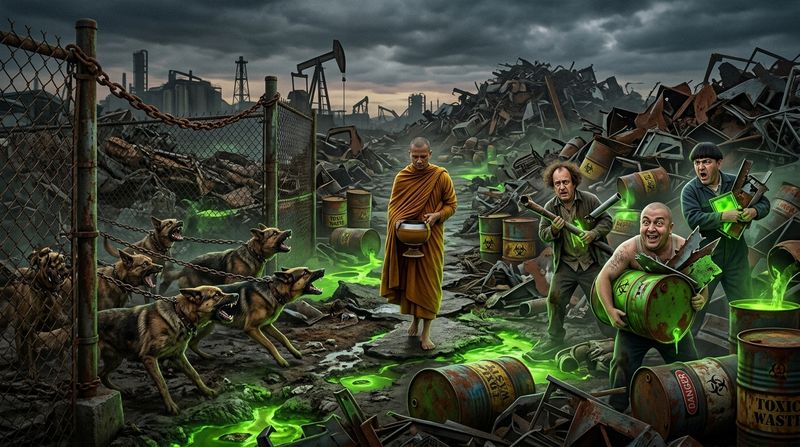
Picture a junkyard.
Toxic green paste glows between rusted barrels leaking who-knows-what.
Sharp metal edges jut out at ankle height.
Chained dogs snarl at the perimeter.
And walking calmly through the middle of it is a monk in saffron robes,
placing each foot with total precision — never near the hazards,
never touching the paste, never provoking the dogs.
Now picture three other people in that same junkyard,
arms already overflowing with jagged scrap and dripping toxic sludge,
grabbing more, laughing, taunting the chained animals as they
go — as if someone announced a free giveaway and they’d better get theirs before it’s gone.
In the physical world, this scene is almost comedic in its obviousness.
Nobody needs to be told that glowing waste is dangerous or that rusted metal will cut you.
The hazards announce themselves.
You don’t need years of training to know: walk here,
not there.
Pick this up, not that.
The discrimination between safe and dangerous is instant,
and mostly effortless.
Now turn the same scene inward.
The junkyard we actually live in
Most people spend their days walking through a mental landscape
that’s just as full of toxic waste and useless junk as that junkyard — except the objects are thoughts,
and somehow all the common sense evaporates.
A resentment from six years ago, still glowing green,
still leaking.
A worry about something that will probably never happen,
sharp-edged and rusted, picked up and turned over and over.
A petty grievance, a comparison, a flash of contempt for someone — junk,
all of it, useless to carry, actively harmful to hold — and people don’t just step near it.
They grab it with both hands.
They hoard it.
They come back for more, the way the Stooges in that scene scoop
up glowing scrap like it’s free treasure being handed out.
And when the toxic paste inevitably does what toxic paste does
— when the accumulated junk starts to hurt — the blame goes outward.
He made me angry.
She ruined my day.
The situation is toxic.
As if the thoughts were an environment that happened to a person,
rather than objects that person reached out and picked up,
one at a time, with their own hand.
This is the strange asymmetry: total discrimination in the physical domain,
none at all in the mental one.
Nobody wanders through a real junkyard passively accepting whatever’s handed to them.
But in the mind, most people run on exactly that policy — accept everything,
discriminate nothing, then wonder why they’re covered in chemical burns.
What first jhāna actually trains
This is where first jhāna becomes relevant — and why it’s a mistake to file it under “advanced monastic meditation, not for me.”
At its core, first jhāna is the skill of doing in the mental
domain what the monk in the junkyard does in the physical one: seeing clearly which ground is safe and which isn’t,
and acting on that discrimination — not picking up the junk,
not stepping in the paste, deliberately walking the clear path instead.
That’s it.
That’s the whole move.
You notice a thought arising — is this skillful ground or toxic waste?
You let the toxic ones pass without picking them up.
You reach for the skillful ones (vitakka),
turn them over (vicāra), water them with pīti and sukha,
and watch them flourish.
And critically — this is the part people skip — when you actually get good at only handling clean material,
something happens: a kind of ease sets in.
The body relaxes. (passaddhi/pacification awakening factor)
There’s a real, physical pleasure (sukha) in it,
not just a moral tidiness.
That relaxed, pleasurable, unburdened state — hands finally empty of glowing junk — is in the first jhāna spectrum.
It is not a mystical trance.
It’s what it feels like to stop hoarding garbage.
Why laypeople have the advantage here, not the disadvantage
Here’s the part that flips the usual assumption.1
People think of jhāna practice as something that requires a silent retreat,
robes, a mountain monastery — an escape from the junkyard,
not a walk through it.
But notice: the junkyard in the image isn’t a metaphor for renunciation.
It’s a metaphor for ordinary life.
And whose life is more densely packed with junkyard material — more insults to not pick up,
more anxieties not to hoard, more opportunities per hour to
discriminate skillful from toxic — a monastic in a quiet monastery,
or a layperson in traffic, in open-plan offices,
in group chats, in family dinners, in inboxes?
A layperson’s day is wall-to-wall toxic waste and free-seeming junk.
Which means a layperson’s day is also wall-to-wall opportunity
to train exactly the skill first jhāna requires: look at the object,
discriminate, and only pick up what’s actually worth carrying.
You don’t need a week of silence to practice this.
You need the next irritating email.
The practice, restated plainly
You already know how to do this.
You do it every time you walk through a parking lot without touching a broken bottle.
The only step left is pointing that same discriminating attention
inward — toward what arises in the mind — and applying the same
rule you’d never think twice about applying to glowing barrels: I see it.
I’m not picking that up.
Do that consistently enough, and stop blaming the junkyard for what you chose to carry,
and you’ll find the relaxed, quietly pleasurable clarity that first jhāna describes — not as a retreat from daily life,
but built entirely out of it.
Conclusion: master of the ways of thought
The Buddha put the whole junkyard skill into a few lines at the
end of MN 20. The monk who has trained in its five methods for
dealing with unwanted thoughts earns a title: master of the ways of thought.
He thinks the thoughts he wants to think,
and he doesn’t think the ones he doesn’t.
That is the essence of the first jhāna.
In first jhāna, the only thoughts you pick up are the ones based on skillful Dharmas.
MN 20 · 20.10.5 (master of thought)
| Pāḷi | English |
|---|---|
| §10.5 – (Master of thought thinks what he wants, doesn’t think what he doesn’t want) | |
| ayaṃ vuccati, bhikkhave, bhikkhu | A monk [skilled in these 5 methods] is called |
| vasī vitakka-pariyāya-pathesu. | a master of the ways of thought. |
| yaṃ vitakkaṃ ākaṅkhissati | Whatever thoughts he wishes [to think], |
| taṃ vitakkaṃ vitakkessati, | he thinks those thoughts. |
| yaṃ vitakkaṃ n-ākaṅkhissati | Whatever thoughts he does not wish [to think], |
| na taṃ vitakkaṃ vitakkessati. | he doesn’t think those thoughts. |
| ac-checchi taṇhaṃ, | Fully cutting off craving, |
| vivattayi saṃyojanaṃ, | Having Flung away the fetters, |
| sammā mān-ābhisamayā | With the Right penetration of conceit, |
| anta-m-akāsi dukkhassā”ti. | He has reached the end of suffering.” |
| ♦ idam-avoca bhagavā. | This was what the Blessed one said. |
| attamanā te bhikkhū | The monks were satisfied and |
| bhagavato bhāsitaṃ abhi-nandunti. | delighted in the Blessed one’s words. |
| ♦ vitakka-saṇṭhāna-suttaṃ niṭṭhitaṃ | The discourse on the relaxation of [unwanted] thoughts is finished. |
1 The lay life only becomes an advantage
once you have a prerequisite amount of samatha (serenity) —
enough competence to suppress the five hindrances at will.
Without that, the balance tips one of two ways.

Too much vipassanā with not enough samatha is the warrior with the spoon.
Too much samatha without vipassanā is the emaciated skeleton
sitting there stroking his blade, sharpening the sword beyond usefulness.
Fourth jhāna is the warrior in the center:
a sharp sword, and he practices swinging it
every day, every moment,
against any defilement that dares show its face.
Silent retreats focused on quiet sitting and quiet walking have their place.
But first jhāna skills can be practiced in any posture and any activity:
keeping the mind lucid,
discerning Dhamma when it’s time for Dhamma
and worldly matters when it’s time for those;
keeping the mind undistractible, with singular focus on whatever you’re doing;
relaxing the body as much as possible (see the JASI effect: AN 7.61 and the video).
Use the rest of the year that way
and you’re training first jhāna skills all the time, in every activity.
Then, when you get to a silent retreat once or a few times a year,
it actually works,
because you’ve been training the mind to stay singular in focus all along.
Otherwise you waste most of the retreat fighting off distracted thoughts —
because you didn’t do your homework all year.







Better yet, discuss this post on the forum — comments to the blog here often get spammed and ignored.