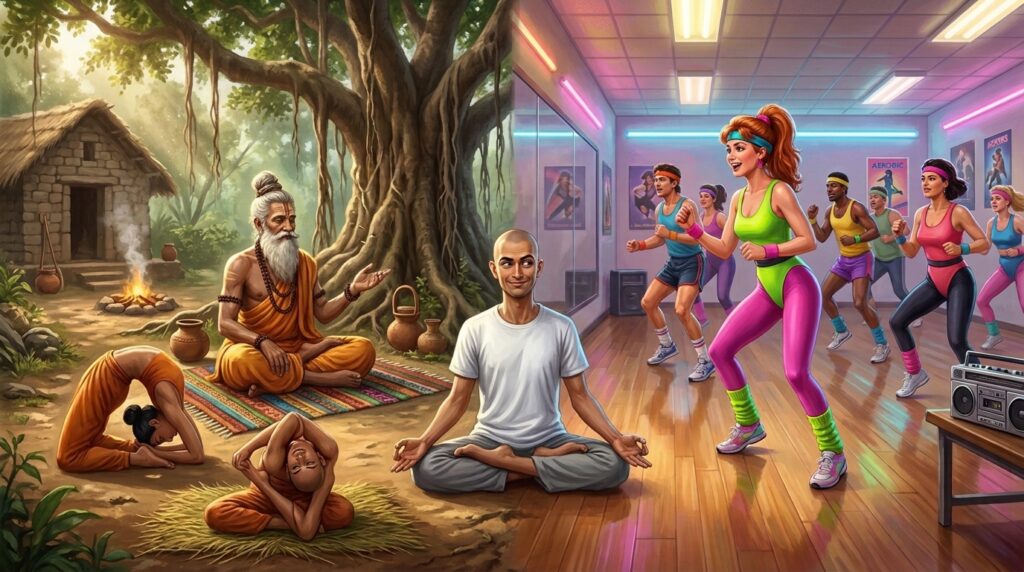
The most blissful yoga session of my life didn’t come from a guru.
It didn’t come from a famous lineage,
or from a teacher who had spent months in an Indian ashram.
It came from an instructor at an ordinary American gym,
one the other yoga teachers mocked behind her back.
They called her ‘Aerobics Jane’.
This is a post about yoga and jhāna,
about how stretching the body can open the door to the jhāna factors,
and about why we should be careful judging a teacher,
or their art and lineage,
by pedigree and credentials.
1. Why I waited decades to tell this story
This was one of the most powerful jhāna experiences of my life,
and it happened in the most unexpected place.
I’ve wanted to share this story for decades.
I held off for two reasons.
First, it doesn’t sound believable.
Second, I couldn’t work out how to tell it clearly.
It’s one of those subtle things you have to reflect on carefully,
and even then the words come slowly.
That’s one reason writing will never go out of style.
In a casual conversation,
or a TV interview,
there’s no time to find the right words.
The talk moves on before you can convey what it actually felt like.
On the page, I can take as long as I need.
So here’s the question I’ve been turning over all these years.
By then I had spent hundreds of hours in yoga classes
with highly credentialed teachers
from impressive lineages in India.
So why did one of the most intense jhāna experiences of my life
come from an uncredentialed aerobics teacher
teaching yoga in an ordinary American gym?
2. A year of trying everything
I found yoga in my early thirties, right around the turn of the millennium.
I lived in a health-conscious town,
and yoga was everywhere there,
years before it took over the rest of the world.
I went at it like a buffet.
For about a year I took every class and workshop I could find:
at my health club, at the studios, anywhere someone was teaching.
Some of the teachers had real credentials.
They had traveled to India,
trained for months at a time under respected gurus,
and could tell you exactly which lineage they came from.
And I enjoyed all of it.
Every one of those classes left me feeling good,
often blissful.
It had to be enjoyable,
or I wouldn’t have kept signing up for so many.
Back then I was uncertain of exactly what jhāna was.
I couldn’t say with confidence whether I could do some version of it,
or where I fell on the spectrum.
But after more than a year of daily yoga,
one thing was clear to me.
Yoga pacifies the body,
and a pacified body is essential for jhāna.
3. Passaddhi: the step right before samādhi
The Buddha has a word for this: passaddhi, pacification.
It is one of the seven awakening factors,
and it comes in two halves:
kāya passaddhi, the body calming down,
and citta passaddhi, the mind calming down.
Where it sits in the sequence matters.
Rejoicing (pāmojja) in skillful Dharmas, in this case your own,
gives rise to mental joy (pīti, usually translated as ‘rapture’).
Mental joy lets body and mind pacify (passaddhi).
A pacified body feels physical pleasure (sukha).
And a mind at ease in pleasure settles into samādhi, the four jhānas.
(See SN 46.2 and SN 46.3.)
So pacification isn’t an optional extra.
It’s a critical prerequisite,
the step right before you land in the jhāna spectrum.
4. What I mean by ‘yoga’
When I say yoga I don’t only mean the stretching and the breathing.
I mean the whole culture around it too,
the ethics and the spiritual teaching.
Several of my teachers followed Patañjali’s Yoga Sūtras
and taught that side seriously.
So you’d expect my deepest experiences to have come from them,
the senior teachers with years in India behind them.
They didn’t.
5. Aerobics Jane
Jane taught at my health club,
a typical American gym:
racks of free weights, rows of weight machines,
and classes like aerobics and kickboxing.
Even in a health-conscious town,
a gym offering yoga at all was unusual back then.
The credentialed teachers didn’t think much of her.
They said ‘Aerobics Jane’ with an eye roll,
because aerobics was what she had mostly taught before.
Her yoga training was short and covered the basics:
the physical stretches and some breathing.
None of the philosophy, none of the lineage.
And she didn’t stay inside the lines.
She’d take a pose and add her own tweaks,
things she had worked out for herself to help the body let go further.
No guru had signed off on them.
They just worked.
6. Relax, don’t instruct
Jane’s strength was that her focus was plain and direct:
relax.
She may never have put it in so many words,
but you could see it in how she demonstrated a pose.
Take a standing forward bend.
Instead of just folding over and holding still,
she’d let her upper body move a little.
A gentle sway from side to side.
Letting the head hang and loosening the neck,
moving it around a bit.
All of it in service of relaxing more,
so the body could sink further into the stretch on its own.
And she stayed in poses longer.
If a pose felt good, you stayed in it,
sometimes for a few minutes in a standing forward bend.
Why stop after five breaths
when it’s working so well,
and you can feel everything loosening up and lengthening?
There was no forcing a stretch deeper with muscle and willpower.
The depth came from letting go.
The more ‘serious’ classes were very different.
There, the instruction was full of details:
where your eye gaze is supposed to be,
how many breaths to hold the pose,
what to do on the inhale,
what to do on the exhale,
which muscle to engage, which one to lengthen.
Every detail was one more thing to monitor and get right.
And all that monitoring and getting it right
actually worked against relaxation,
against passaddhi, the very pacification awakening factor that leads to jhāna.
The irony is that the lineage teachers
had all the theory about calming the body and mind,
and their method kept the mind busy.
Jane had none of the theory,
and her method just let the mind settle.
In hindsight, what Jane was teaching
was a purer form of kāya passaddhi and citta passaddhi
than anything I got from the lineage teachers.
The body relaxes,
the mind has nothing to manage,
and the two pacify together.
7. Two hours of bliss, and it didn’t stop
I took a two-hour workshop with her one weekend.
Looking back, it was one of the strongest experiences of
pīti, sukha, and pāmojja (mental joy, physical pleasure, and rejoicing in skillful Dharmas) I’ve had in my life.
I felt it in the body and in the mind.
None of it happened in a formal sitting meditation posture.
The bliss came up while we were stretching,
and it didn’t fade when the workshop ended.
It stayed with me on the drive home.
It stayed while I walked around my apartment,
put things away,
and did whatever ordinary things I did that evening.
For hours my mind rested in bliss and peace,
and I wasn’t trying to do anything to keep it there.
Remember, I enjoyed every yoga class I took.
But strong bliss, in body and mind,
that lasts for hours after the class is over?
That’s an extraordinary experience.
You don’t come across it easily,
or often.
8. Brownies at the end of class

One more thing about Jane captures her energy and style.
At the end of the workshop she brought out a bag of bite-sized treats,
brownies or something like them,
homemade, delicious, and baked by her for everyone in the class.
In all my years of yoga classes,
no other teacher ever handed out treats at the end.
There’s nothing magical about a brownie.
But it shows her whole manner of teaching and communicating.
You could feel the care, the attention, and the friendliness
in everything she did.
That’s one of the reasons my bliss lasted for hours.
Her friendly energy filled the room,
and there was a feeling of communion with my classmates.
We were like kindergarten kids
in a completely safe and protected place,
with a teacher we trusted and loved.
That was the vibe.
8.1 Mettā: the easy road into the jhānas
In hindsight, Jane never taught any theory,
none of the spiritual side of yoga,
and certainly nothing about Buddhism.
But her attitude, her vibe, her energy
was exactly how mettā and the four brahmavihāras
easily lead one into the four jhānas.
9. Decades later: why it worked
It took decades,
and genuine jhāna experience of my own,
before I could finally put into words
exactly why that workshop gave me one of the strongest jhānas of my life,
and explain in detail why it worked.
First, a word about the other teachers.
I don’t mean to denigrate or dismiss
the yoga and spiritual traditions of India.
It’s just that in my particular case,
their spiritual teachings offered nothing
that the early Buddhist teachings (EBT) didn’t already give me.
What I was really exploring in their yoga traditions
was anything that could help my journey into genuine jhāna.
Here are the three most important takeaways.
9.1 Too much technique works against pacification
Yoga methods that are very detailed, complex, and deliberate
can help to some extent.
But past a point they’re counterproductive
to passaddhi, the pacification awakening factor
that comes right before the samādhi of the jhānas.
Every instruction is one more thing for the mind to manage,
and a mind busy managing doesn’t pacify.
9.2 Relaxation is caught, not taught, then practiced everywhere
Jane showed me a purer, more direct way into kāya passaddhi, bodily pacification.
But it didn’t come through technical verbal explanation.
You had to be there, live and in person,
watch her demonstrate relaxation,
and imitate it.
But catching it is only the start.
Learning the theory won’t do it,
and neither will watching someone else be relaxed.
If you want to relax deeper,
you have to make an extraordinary commitment
to pacify the body all the time:
in every activity,
in every posture.
Keep trying, keep practicing, keep refining.
Find where you’re still tight,
and keep dissolving every hard area in the body.
And I don’t think you could put a room full of Buddhist students in her class
and suddenly have everyone getting jhāna.
There are other important prerequisites:
good sīla (ethics),
healthy eating and a healthy lifestyle,
and celibacy to charge the jhāna battery
and build up the jhānic force.
To be clear about celibacy:
you don’t need it for a weak or mediocre first jhāna.
But if you want to develop competent, highly skilled jhāna
across the whole spectrum of the four jhānas,
you will need it.
9.3 NWBH: not what, but how
It ain’t what you do,
it’s the way that you do it.
That’s what gets results.
The right time, the right place, the right way,
not the right credentials or an impressive lineage.
Some of the dumbest people I’ve ever met,
and had the misfortune of working with,
graduated from the most elite universities in the world.
Whatever skills you practice daily,
if you’re not improving,
you can usually trace it right back to NWBH.
Some careful introspection will diagnose
what you might be doing wrong,
and what you can change to get the results you want.
10. Lessons learned
Pacify the body first.
A tight, restless body keeps dragging attention back to itself.
An intelligent distillation of relaxation techniques
from yoga, qigong, taiji, and the like
melts that tension and softens the body.
Then kāya passaddhi takes hold,
and the mind tends to follow.
If you struggle to settle on the cushion,
you may be trying to skip a step.
Jhāna isn’t just for sitting still.
My bliss started in a stretch and carried on behind the steering wheel.
The Buddha’s samādhi is meant to work in all four postures:
walking, standing, sitting, and lying down.
And any activity can hold some fraction of jhāna.
But it won’t happen unless you know it’s possible:
that it was taught, and that it’s expected.
Almost no Buddhist teachers teach that.
So if you’re lucky enough to come across it,
really dig in and find out how to do it.
Judge a teacher by results, not pedigree.
The teacher with the weakest credentials gave me the deepest experience.
And there’s a famous precedent.
10.1 The Buddha as a boy discovers first jhāna
The Bodhisatta trained under the two most celebrated meditation teachers of his day,
and still left both.
What finally pointed him to the path
was a memory from his childhood:
sitting under a rose-apple tree,
falling into first jhāna on his own, with no teacher at all.
Most teachers read that as proof of extraordinary merit:
countless past lives of perfecting the pāramīs
gave the Bodhisatta the genius to discover first jhāna.
But examine all the relevant suttas on first jhāna,
and the answer turns out to be much simpler,
and much more useful to anyone who doesn’t have first jhāna yet and wants it.
Getting a few seconds of first jhāna is actually very easy.
The body is deeply relaxed.
The mind is very peaceful,
and holds a theme relevant to Dharma.
Many suttas show the Buddha expecting new monks,
and even lay people,
to practice the jhānas with some competence.
If first jhāna were so difficult and extraordinary,
why would he ask that of us?
It was just like that in Aerobics Jane’s workshop.
First jhāna can be that simple and that easy to get.
I didn’t even know I’d had it until years later,
because of all the misinformation about jhāna out there.
That’s why my story parallels the essence of first jhāna so closely.
Both are extraordinarily simple
and profound at the same time.
Both sound too good to be true,
so most people don’t believe them.
You probably won’t really understand either one
until you experience it yourself.
Kindness is a shortcut to jhāna.
Jane’s warmth did as much for my bliss as her stretches did.
A safe, friendly, caring atmosphere is mettā in action,
and mettā is one of the easiest roads into the jhānas.
Pacification alone isn’t the whole path.
Jane taught no ethics and no philosophy, and the pacification worked anyway.
Like autonomous jhāna,
it doesn’t check what you’re thinking about.
What makes it sammā samādhi, right samādhi,
is a mind occupied with Dharma,
resting on a foundation of sīla.






Better yet, share your thoughts on the Notes on the Dhamma forum — comments to the blog here often get spammed and ignored.