
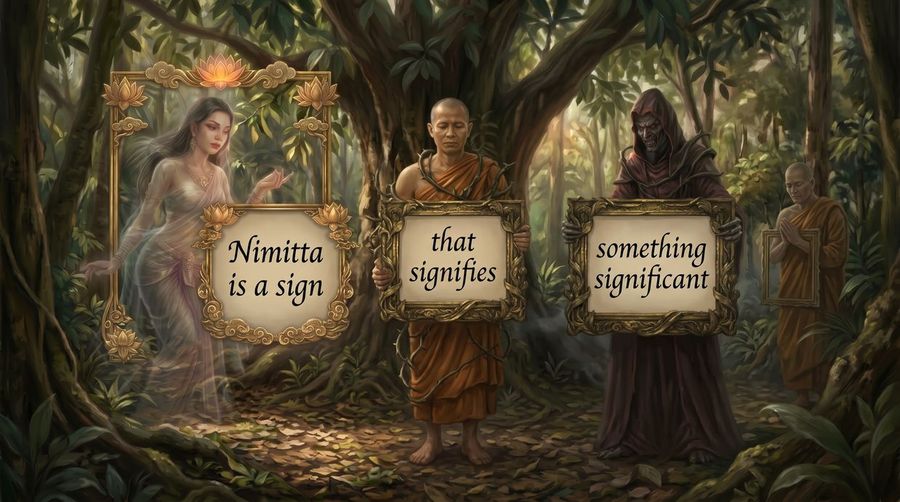
This is why I try to consistently translate nimitta as “sign” everywhere.
Because you lose the connection to the Pāḷi word if you translate a subtle English meaning in each context,
such as these in the DPD dictionary:
- nimitta 1 nt. mark; sign; symbol; indication; lit. measured down
- nimitta 2 nt. mental feature; aspect of experience; lit. measured down
- nimitta 3 nt. sign; omen; portent; lit. measured down
- nimitta 4 nt. (interpretation of) signs; omens; portents; lit. measured down
- nimitta 5 nt. cause; reason; foundation; basis; lit. measured down
- nimitta 6 nt. meditation object; theme of contemplation; mental hyperlink; lit. measured down
- nimitta 7 nt. sexual organ; lit. measured down
- nimitta 8 nt. hint; suggestion; clue; lit. measured down
Every one of those is a defensible rendering in its own context.
That is exactly the problem.
Eight different English words means the reader never sees that the Buddha was using one word,
and never gets to notice what all eight uses have in common.
But by translating it consistently with the same English “sign” everywhere, you start to really understand how the Buddha wants you to understand samādhi nimittas.
For the full treatment, see nimitta on lucid24.org,
especially section 99.3. And see the previous post on SN 46.2: you need to recite this every day,
which exemplifies the samādhi nimitta role in leading to jhāna.
99.3 – especially important samādhi nimitta ref’s
- AN 3.102 goldcraft, balancing nimittas of upekkha,
samādhi, paggaha (energy) - AN 4.14.1 guarding 6 sense doors, don’t grab onto signs and features
- AN 4.14.4 samādhi nimittas are 5siv⚰️
- MN 20 nimittas are 5 types of mental activity that are ‘signs’/methods for removing unwanted thoughts and perceptions
- SN 8.4 Vaṅgīsa, turn away from subha nimitta,
develop animitta - SN 46.2 nutriments for hindrances, subha and paṭigha
- SN 47.8 cook simile, follow good nimitta to get samādhi
- SN 47.10 inspiring nimittas are good Dhamma thoughts for vitakka in directed samādhi
A primer on how nimittas (signs) work in EBT
We already do this exact thing in English — we just don’t call it nimitta.
Original version: A primer on how Nimittas (signs) work in EBT,
notesonthedhamma 2022. The version below is that article expanded
with AI assistance — more detail and more polish than the original.
The lesson and the examples are the original’s; follow the link above for it in its own unembellished words.
Lesson 1: Jack and Jill
In the early Buddhist texts there is a curious,
recurring idiom:
“following a sign,” “picking up on a sign,” “paying attention to a sign.”
The word in Pāḷi is nimitta, and there are deep technical reasons the texts lean on it so often.
But it occurred to me recently that we already use this exact idea in plain English,
every day, usually without noticing it.
We say things like “I got a good sign from her” or “that’s a red flag” — we are, whether we know it or not,
doing the same interpretive work the ancient texts are describing.
Here is a story to make it concrete.
Jack and Jill were in high school.
They liked each other — quietly, nervously — and each wanted very badly to let the other know it.
But both were shy, and neither had the life experience yet to know how such things are communicated.
This was also a time when girls were not expected to make the first move,
so the entire weight of the situation rested on Jack.
He alone had to find a way to establish,
without saying it outright, that he liked her.
Jack tried.
Jack failed.
Why?
He didn’t follow the right nimittas.
It isn’t that the world failed to give him signs — it gave him plenty.
He simply didn’t attend to the right ones.
He attended to the wrong ones instead,
and mistook his own misreading for insight.
Consider what the right signs actually were.
When Jack worked up the nerve to approach Jill and start a conversation,
she smiled — not a polite, closed-mouth smile,
but a real one.
Her greeting was warm.
And her body language, the way she turned toward him,
the way she stayed in the conversation rather than looking for an exit,
was unmistakably that of someone engaged and interested.
That’s three good nimittas, freely given,
before he’d even said anything memorable.
And what did Jack do with them?
He explained them away.
She’s just like that with everyone, he told himself.
She’s a nice person, that’s all this is.
This was Bad Nimitta #1 — and its damage wasn’t that it existed,
but that Jack let it override three pieces of good evidence
rather than simply sitting with the ambiguity a little longer.
A wiser response would have been to hold the three good signs loosely,
let them accumulate, and see what the moment offered next.
Instead, he used one flimsy explanation to erase all three at once.
The moment did offer more.
Jack, growing bolder, attempted a joke — and it was not a good joke.
It was, by any honest measure, a bad joke.
And yet Jill laughed.
She laughed heartily, generously, in a way that had nothing to
do with the actual quality of the material and everything to do with wanting Jack to feel good in that moment.
This is its own kind of nimitta, and a particularly telling one
— people do not spend genuine warmth on jokes they don’t care about,
or on people they’re indifferent to.
That makes four good nimittas now, and this one arguably the clearest of all.
Jack, naturally, followed Bad Nimitta #2 instead: that joke was just objectively funny,
that’s all — anyone would have laughed at that.
(No. No, they would not have.
Reader, you would not have.) It is a strange feature of the unwise
mind that it can look directly at generosity and rename it coincidence.
And yet — credit where it’s due — despite feeling,
by this point, like the whole endeavor was doomed,
Jack found something in himself.
Call it courage, call it recklessness born of desperation,
call it a nimitta of its own, good or bad or simply neutral,
hard to say.
Whatever it was, it moved him to ask Jill out for that Friday.
Jill said: “Sorry Jack, Bob already asked me out on a date this Friday.”
Here is where the story turns, and here is where it’s worth slowing down,
because this single sentence contains a small universe of interpretive possibility,
and Jack chose the worst one available to him.
He followed Bad Nimitta #3 — the leap,
instantaneous and unexamined, that she must like Bob,
and not me — as though a single scheduling conflict were proof of a settled heart.
This is the nature of an unwisely followed sign: it doesn’t just mislead you,
it feels like certainty while it does so.
Jack didn’t experience this as a guess.
He experienced it as a fact he’d just learned.
Had Jack possessed a bit more paññā — a bit more wisdom in the
moment — he might have generated a good nimitta of his own instead of merely reacting to a bad one.
He could have simply asked: “Are you and Bob boyfriend and girlfriend?”
Four words.
A question, not a verdict.
It would have cost him nothing and told him everything.
He didn’t ask it.
And here is the detail that makes the story ache a little: Jill,
in that same silence, was holding her own half-formed sentence.
She wanted — genuinely wanted — to say,
“But maybe we could go out next week?”
It was right there, ready.
But her shyness, and the general conservatism of how she’d been raised to carry herself,
made her hesitate.
Just a beat too long.
One breath.
And in that single beat, the window closed — not because it had to,
but because both of them were, in that instant,
prisoners of the same unexamined signs,
each one waiting for a clarity the other was too afraid to offer first.
Jack ran off crying.
Jack, in the end, wasn’t foolish for lacking evidence.
He had evidence — at least five good nimittas along the way,
freely offered, unambiguous in retrospect.
He was foolish because what he practiced was a·yoniso manasi·kāra.
Rendered “unwise attention,” that term only tells you that you blew it; it doesn’t tell you what to do instead.
But yoni is the womb, the origin, the source — so yoniso manasi·kāra
is the mind working its way back to where a thing came from,
the mind tracing the source, and that is an instruction you can actually act on.
Jack never traced a single sign back to where it came from.
Had he followed the laugh back to its origin he would have found affection,
not comedy.
Had he followed “Bob already asked me out” back to its origin he would have found a calendar,
not a verdict.
Instead he took each sign at its surface and fixated on three bad nimittas of his own manufacture,
each one a small act of self-sabotage dressed up as realism,
until together they built a conclusion that felt,
to him, like the truth: that the whole thing had been hopeless from the start.
It hadn’t been.
It had simply gone untraced.







Better yet, discuss this post on the forum — comments to the blog here often get spammed and ignored.